AI E-Commerce: How Women Are Building $5,000/Month Shopify Stores With AI Product Photos and Ad Creatives
AI is turning product research, photography, and ad creative into a one-woman operation. Here is the exact playbook women are using to hit $5,000/month on Shopify.
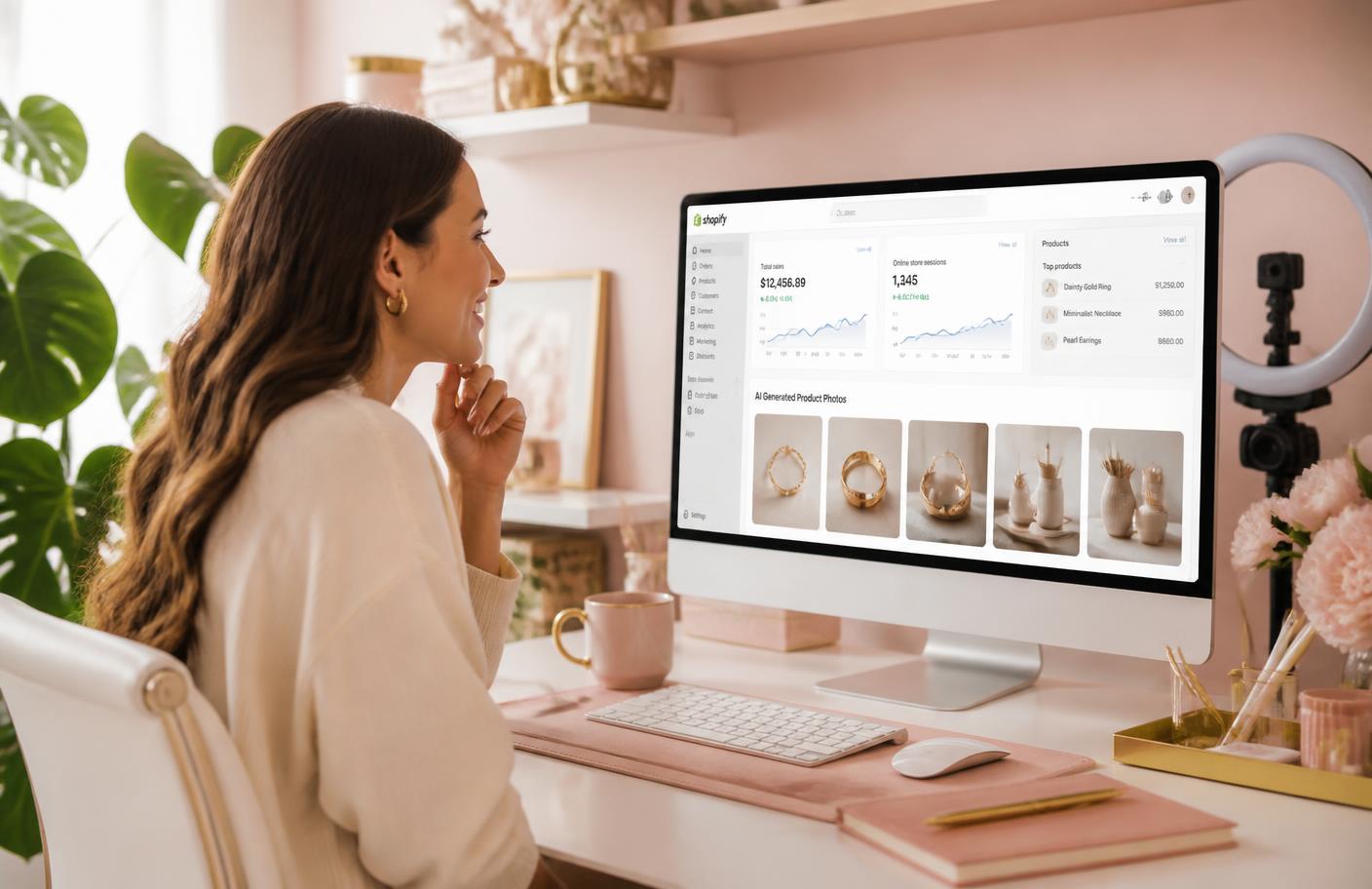
The most unfair advantage in online retail right now is not a warehouse, a factory, or a venture capital check. It is a woman with a laptop, a Shopify trial, and a handful of AI tools that do the work an e-commerce team of five used to do. In 2026, AI e-commerce is the fastest path from idea to revenue for women founders who do not want to hold inventory, hire photographers, or spend thousands testing ads.
This guide covers the complete system: finding a product, generating images that look like a $10,000 photo shoot, writing ads that convert, and automating the boring parts. By the end you will have a 90-day plan to reach $5,000 in monthly sales.
Key Takeaways
- AI product photography and ad creative generation have collapsed the startup cost of an e-commerce brand.
- The winning model is small catalog, high margin, fast creative testing - not massive inventory.
- Shopify plus AI tools for email, chat, and analytics can run a one-person store profitably.
- Women founders often win in niches where they are also the customer: wellness, home, beauty, baby, pets, and organization.
- External links to authority sources improve trust and SEO; internal links keep readers inside your ecosystem.
Why AI E-Commerce Favors Women Right Now
Traditional e-commerce rewarded whoever could spend the most on ads and inventory. AI e-commerce rewards whoever understands the customer best. Women founders consistently outperform in categories where empathy, taste, and community matter: skincare, home organization, motherhood, fitness, and self-care. According to the U.S. Small Business Administration, women-owned businesses are growing at twice the rate of the national average, and e-commerce is the most common first channel.
AI removes the three biggest historical barriers:
- Product photography. Tools like Midjourney, Ideogram, and Shopify's built-in AI editor create catalog-quality images from descriptions or phone snapshots.
- Ad creative. You can generate and test fifty variations of a Meta ad in an afternoon instead of waiting two weeks for a designer.
- Copy and support. Product descriptions, email flows, and chat replies can be drafted and optimized with AI, then reviewed by you.
The result is a store that looks premium but runs lean. Start with our breakdown of the best AI tools for women entrepreneurs to build your stack.
Step 1: Pick a Product You Can Explain in One Sentence
The biggest mistake new founders make is selling a product. The winners sell an outcome. "Stainless steel water bottle" is a product. "The bottle that keeps busy moms hydrated without leaking in a diaper bag" is an outcome.
Use AI to research demand, not to pick your passion. Ask ChatGPT or Perplexity to summarize Reddit threads, Amazon reviews, and TikTok comments around a problem you already understand. Look for:
- A specific frustration people describe repeatedly.
- Existing products with 3-4 star reviews that "almost" solve it.
- A price point where people complain but still buy.
Your first product does not need to be unique. It needs to be better positioned. For a deeper look at product creation, read our guide to selling AI digital products; the same research rules apply.
Step 2: Build the Store in a Weekend
Shopify remains the simplest platform for a standalone brand. The AI store builder can generate a homepage, product pages, and navigation from a short prompt. Do not over-design. Your store needs five things: a clear headline, a hero product image, a benefits section, social proof, and a checkout button.
Set up the back end with:
- Payments: Shopify Payments plus PayPal for trust.
- Fulfillment: Print-on-demand for custom products, or a domestic dropshipper for faster shipping.
- Email: Klaviyo or Shopify Email with an abandoned-cart sequence.
- Analytics: Triple Whale or Shopify's native reports to see which ads actually profit.
If you want a lower-risk inventory model, compare this with our AI print-on-demand guide, which uses Etsy and Shopify together.
Step 3: Create Product Images That Look Like a $10,000 Shoot
You no longer need a photographer, studio, or model. The workflow most women founders use in 2026 looks like this:
- Photograph the product on a clean surface with your phone.
- Use an AI background removal tool to isolate it.
- Generate lifestyle scenes with AI: "minimalist bathroom shelf with soft morning light, cream and sage tones, ceramic accessories."
- Composite the product into the scene and adjust lighting to match.
The key is consistency. Every image should feel like it came from the same brand world: same light, same palette, same mood. AI makes iteration cheap, so generate twenty and keep the five that feel most premium.
Step 4: Write and Test Ad Creatives at Speed
Meta's AI ad tools, along with third-party creative platforms, let you generate dozens of image and video variations from a single product shot. The goal is not one perfect ad. The goal is to find the winning angle quickly.
Test three creative angles:
- Problem-solution: "Tired of bags that leak?"
- Social proof: "10,000 moms switched this month."
- Aspirational: "The 30-second morning routine that actually works."
Start with a small daily budget, kill losers within 72 hours, and double down on anything with a cost-per-purchase below your margin. For automation that scales this process, see our AI automation agency playbook.
Step 5: Automate Retention, Not Just Acquisition
Most first-time founders obsess over new traffic and ignore the customers they already paid to acquire. AI makes retention almost automatic:
- Welcome series: AI drafts a 5-email sequence that introduces the brand story.
- Abandoned cart: Personalized subject lines and product reminders.
- Post-purchase: Review requests, usage tips, and cross-sells.
- Win-back: A gentle re-engagement campaign for customers who have not bought in 90 days.
Email often contributes 30-40% of revenue for successful one-person stores. It is also where AI saves the most time, because the same voice can be reused across every campaign.

Step 6: Add Affiliate and Organic Traffic Layers
Once the store is profitable from paid ads, add two free-ish growth channels. First, an affiliate program where micro-influencers earn a commission. Second, organic content: TikTok, Instagram Reels, and Pinterest pins that show the product in real life. AI can repurpose one video into ten pieces of content.
We cover the affiliate model in detail in our AI affiliate marketing guide. The same creators who promote your product can become long-term brand partners.
30-Day Launch Plan
- Days 1-7: Research and validate one product idea using AI-summarized reviews.
- Days 8-14: Build the Shopify store, create product images, and set up email flows.
- Days 15-21: Launch three Meta ad angles with a $20/day budget each.
- Days 22-28: Kill losing ads, scale winners, and add organic content.
- Days 29-30: Review numbers, optimize checkout, and plan your second product.
Frequently Asked Questions
Do I need inventory to start?
No. Print-on-demand and domestic dropshipping let you test products before ordering in bulk. Only buy inventory once you have proven demand.
How much does it cost to start?
A lean start costs $200-$500: Shopify trial, domain, sample product, and initial ad spend. Many founders start with no paid tools beyond ChatGPT.
What products work best with AI marketing?
Visual products with a clear emotional benefit: beauty, home decor, wellness, baby, pets, organization, and fashion accessories.
Is dropshipping still viable in 2026?
Generic AliExpress dropshipping is hard. Curated, branded, fast-shipping products still work. AI helps you look premium even when you are small.
How long until $5,000/month?
With consistent testing, most founders reach $5,000/month in sales within 90-120 days. Profitability depends on margin, typically 20-35% after ads and fulfillment.
The Bottom Line
AI e-commerce is not about replacing judgment. It is about removing the repetitive work that used to stop women from starting. You still choose the product, define the brand, and talk to customers. AI handles the photos, copy, and testing so you can focus on what actually grows revenue.
Start this week: validate one product, build one Shopify page, and test one ad. Then scale with the best AI tools for women entrepreneurs, automate operations using the automation agency playbook, and explore affiliate traffic once you have traction.
Loved this article?
Share it with a friend who's ready to build wealth with AI — or subscribe for daily trending topics.
You might also like
The AI Executive Assistant Business: How Women Are Charging $2,500–$6,000 a Month to Run Founders' Lives
Ordinary VA work pays $20 an hour. AI-powered executive support pays retainers. Here is exactly how women are packaging and selling the difference.
The $10,000/Month Newsletter: How Women Are Using AI to Build Tiny Media Businesses in 2026
No algorithm, no camera, no ads to buy. Just an inbox list you own — and AI doing 70% of the research and drafting work.
The AI Automation Agency: How Women Are Charging $2,000–$8,000 a Month to Fix Other People's Busywork
The highest-paying beginner-friendly AI business of 2026: selling automations to small businesses. Services, pricing, client sources, and a 30-day launch plan.